
Benefits of Surah At-Tur: Five Oaths, Paradise Reunions, and “In Our Eyes”
The Surah That Swears Five Times Before Its First Point
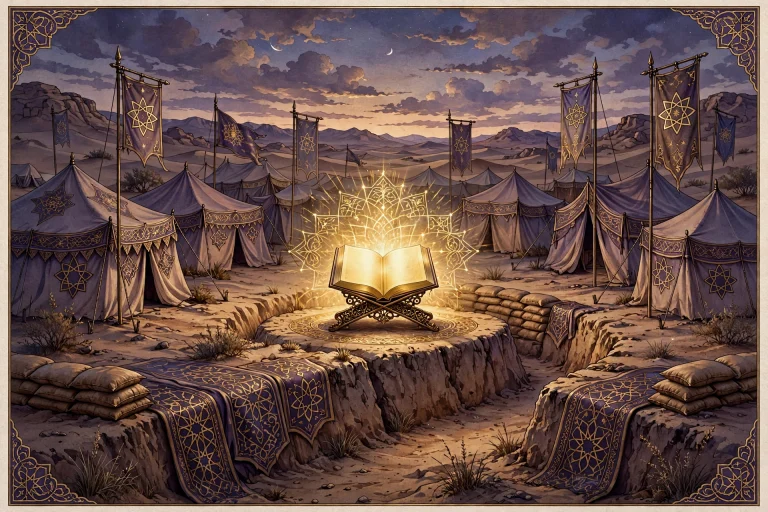
Allah does not need oaths — so when He opens a surah with five of them, the point that follows deserves your full attention. Surah At-Tur (“The Mount”) swears by Sinai, by a written Book, by the angels’ Ka’bah, by the sky, and by the sea — then delivers its verdict.
The problem: A hazy, half-believed Afterlife — real enough to mention, unreal enough to ignore.
The solution: Five oaths converging on one certainty: “Indeed, the punishment of your Lord will occur” (52:7). In this guide: the oaths, the two destinations described, the logic challenge, and the verse of comfort.
Surah Snapshot
| Detail | Fact |
|---|---|
| Surah number | 52 (At-Tur — “The Mount,” i.e., Sinai) |
| Verses | 49 |
| Revelation | Makki |
| Juz | 27 |
| Core themes | Certainty of the Hour, Paradise and Hell, the Creator’s necessity, divine care |
The Five Oaths (52:1–6)
- By At-Tur — Mount Sinai, where Allah spoke to Musa
- By a Book inscribed — in unrolled parchment; scholars say the Quran (or the Preserved Tablet)
- By Al-Bayt al-Ma’mur — the Frequented House, the angels’ Ka’bah above the earthly one
- By the elevated canopy — the sky
- By the sea filled — interpreted as filled with water, or (per some reports) kindled with fire
Then the sworn statement: “Indeed, the punishment of your Lord will occur. Of it, there is no preventer” (52:7–8). When the Quran stacks oaths like this, scholars say, it is answering deep denial — the kind that needs more than one witness.
Paradise: Reunion Included (52:17–28)
The surah’s Paradise passage is unusually social: gardens and bliss, thrones, joyful conversation — and then 52:21: “And those who believed and whose descendants followed them in faith — We will join with them their descendants, and We will not deprive them of anything of their deeds.”
Children who shared the faith are elevated to their parents’ rank, “though their deeds fell short” — a mercy scholars highlight for every anxious parent. The inhabitants themselves reflect: “Indeed, we were before among our people, fearful [of Allah]” (52:26) — their worldly fear became their eternal relief.
Hell: Denial Answered (52:11–16)
“Then woe, that Day, to the deniers… The Day they are thrust toward the fire of Hell with a [violent] thrust… ‘Is this magic, or do you not see?'” (52:11–15). The taunt mirrors their worldly mockery of revelation as “magic” — now the tables turn. The surah’s contrasts are deliberate pedagogy: read both destinations, then choose daily.
Key Verses to Reflect On
| Verse | Theme |
|---|---|
| 52:21 | Family reunion in Paradise |
| 52:35–36 | The three-option logic challenge |
| 52:48 | “Be patient… indeed, you are in Our eyes” |
The Three Options (52:35–36)
“Or were they created by nothing, or were they the creators [of themselves]? Or did they create the heavens and the earth? Rather, they are not certain.”
Scholars present this as a complete logical enclosure: from nothing (impossible — nothing produces nothing), by themselves (absurd — existence must precede the act), or creators of the cosmos (no one claims this). The remaining option — a Creator — is the only one standing. It is among the Quran’s most quoted rational arguments, and Jubayr ibn Mut’im reportedly embraced Islam upon hearing these very verses (Bukhari).
“You Are in Our Eyes” (52:48)
“And be patient, [O Muhammad], for the decision of your Lord, for indeed, you are in Our eyes.”
Divine watchfulness as care, not surveillance. Commentators explain: just as you protect what is before your eyes, Allah guards His servant — the verse was revealed amid Makkan persecution, and it extends to every believer under pressure. Patience is commanded; abandonment is denied.
Practical Takeaways
- Treat the Hour as certain — five oaths is the Quran’s emphasis marker (52:1–7)
- Invest in family faith — shared belief reunites across ranks (52:21)
- Use the logic — the three options settle the Creator question (52:35–36)
- Rest in His sight — trials happen within His watchful care (52:48)
Frequently Asked Questions
Q: What is At-Tur?
A: Mount Sinai, where Allah spoke to Musa (20:11–14). The surah opens by swearing by it among four other weighty things.
Q: Will families really be reunited in Paradise?
A: Per 52:21, believing descendants are joined with their parents and elevated to their rank by Allah’s favor — a widely-cited mercy for families. The condition stated is shared faith.
Q: Is there a specific hadith about reciting Surah At-Tur?
A: There is no widely-authenticated hadith promising a specific reward for this surah alone. Its benefit is in its certainty-building — oaths, destinations, and logic — taken to heart.
Q: How do the “three options” prove a Creator?
A: Scholars formalize it: (1) from absolute nothing — rejected by reason; (2) self-creation — logically incoherent; (3) creating the universe themselves — unclaimed. The Creator remains as the necessary explanation. Jubayr ibn Mut’im’s conversion on hearing it (Bukhari) shows its historical force.
Summary
Surah At-Tur — 49 Makki verses: five oaths for one certainty, Paradise with family reunions, Hell for deniers, logic for doubters, and comfort for the tested. Read it when the Afterlife feels abstract — the surah’s whole design is to make it concrete.
Make the Afterlife concrete through knowledge: Book 3 free classes → · WhatsApp us