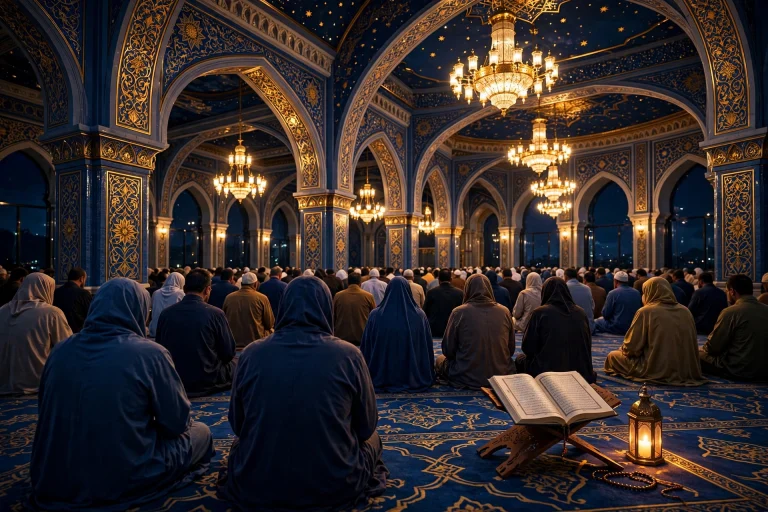

Benefits of Surah Ad-Dukhan: The Blessed Night, the Smoke, and an Easy Quran
The Surah Named After a Warning
Most surahs are named for their mercy; this one is named for smoke — a visible torment. Yet it opens with one of the Quran’s most hope-filled passages. That tension is the surah.
The problem: Treating divine warnings as distant fiction — and the Quran as difficult.
The solution: The surah pairs its warning with the Blessed Night’s mercy and ends by declaring the Quran easy. In this guide: the night, the smoke, Pharaoh’s end — and an honest note on a famous narration.
Surah Snapshot
| Detail | Fact |
|---|---|
| Surah number | 44 (Ad-Dukhan — “The Smoke”) |
| Verses | 59 |
| Revelation | Makki |
| Juz | 25 |
| Core themes | Laylatul Qadr, divine warnings, Pharaoh’s fall, Quranic ease |
The Blessed Night (44:3–4)
“Indeed, We sent it down during a blessed night. Indeed, We were to warn [mankind]. On that night is made distinct every precise matter.”
Commentators identify this as Laylatul Qadr — the Night of Decree in Ramadan, when the Quran’s revelation began and when, per 97:4, the angels descend with decrees for the coming year. The surah’s placement of this mercy before its warnings is deliberate: the door is described before the consequences of ignoring it.
The Smoke (44:10–11)
“Then watch for the Day when the sky will bring a visible smoke, covering the people; this is a painful torment.”
Scholars offer two main readings: a sign of the approaching Hour, or the famine that struck Makkah (when the disbelievers, per reports, saw smoke-like haze from hunger). Either way, the surah’s point stands — warnings precede consequences, and heedlessness has a cost.
Pharaoh’s End, Retold (44:17–33)
The surah compresses the Musa–Pharaoh confrontation: the demand (“send with me the Children of Israel”), the refusal, the drowning — and then a chilling irony as Pharaoh is told in punishment: “Taste! Indeed, you are the honored, the noble!” (44:49) — the very titles he claimed, turned to mockery.
Key Verses to Reflect On
| Verse | Theme |
|---|---|
| 44:3 | The Blessed Night of revelation and decree |
| 44:38–39 | “We did not create the heavens and earth and what is between them in play” — purpose |
| 44:58 | “We have made it easy in your tongue” — accessibility |
“We Have Made It Easy” (44:58)
“And indeed, We have eased the Quran in your tongue that they might be reminded.”
The surah that warned of smoke closes by removing your last excuse. Easy — in language, in memorization, in access. Scholars say this verse answers everyone who ever said “the Quran is too hard for me”: Allah Himself testifies otherwise.
An Honest Note on the “70,000 Angels” Narration
You may have seen it quoted: “Whoever recites Ad-Dukhan at night, seventy thousand angels seek forgiveness for him until morning” (attributed to Tirmidhi). Honesty requires the full picture: scholars differ on this narration’s grading, and many — including Al-Albani — graded it weak (da’if). At-Tirmidhi himself transmitted it as a solitary (gharib) report.
This does not make nightly recitation worthless — reciting any Quran at night is established worship — but a specific reward should not be promised on a disputed report. The surah’s certain benefits (its themes, its ease-verse, its warnings) are benefit enough.
Practical Takeaways
- Seek the Blessed Night — in Ramadan’s last ten nights, especially the odd ones (44:3; Bukhari)
- Heed warnings early — the smoke passage is mercy before consequence (44:10–11)
- Drop the “too hard” claim — the Quran testifies to its own ease (44:58)
- Stay humble — Pharaoh’s titles became his taunt (44:49)
Frequently Asked Questions
Q: What is “the smoke”?
A: Scholars give two main views: a future sign of the Hour, or the historical famine in Makkah. The surah’s emphasis is on heeding warnings, whichever reading one follows.
Q: Is the 70,000-angels hadith authentic?
A: Scholars differ; many grade it weak (da’if). Nightly Quran recitation is meritorious regardless, but the specific reward should not be stated as certain.
Q: When is Laylatul Qadr?
A: The Prophet ﷺ instructed seeking it in the last ten nights of Ramadan, emphasizing the odd nights (Bukhari, Muslim). No one knows its exact date — that is the wisdom: seek all ten.
Q: Why does the surah end with “easy”?
A: Commentators see it as the surah’s final mercy — after warnings and stories, the reader is told the Book itself is accessible. The barrier was never the text.
Summary
Surah Ad-Dukhan — 59 Makki verses on the Blessed Night, the smoke of warning, Pharaoh’s ironic end, and the Quran’s self-declared ease. Read it for perspective: warnings are real, mercy is nearer, and the Book is easier than you think.
Learn the Quran with understanding: Book 3 free classes → · WhatsApp us