
How to Read the Quran for Beginners: From Alphabet to Fluency
From “I Can’t Read Arabic” to Reading the Quran
If you’ve ever opened the Quran and felt overwhelmed by unfamiliar script, you’re not alone. Thousands of adults feel exactly the same — and many assume it’s too late for them.
It’s not. Reading the Quran is a learnable skill, not an inborn talent. What you need isn’t genius — it’s a structured path with clear milestones.
This guide gives you a practical 90-day plan in three phases: alphabet (days 1–30), vowels and word formation (days 31–60), and fluency with basic Tajweed (days 61–90). Whether you’re an adult beginner or helping your child, the path is the same.
Phase 1: The Alphabet (Days 1–30)
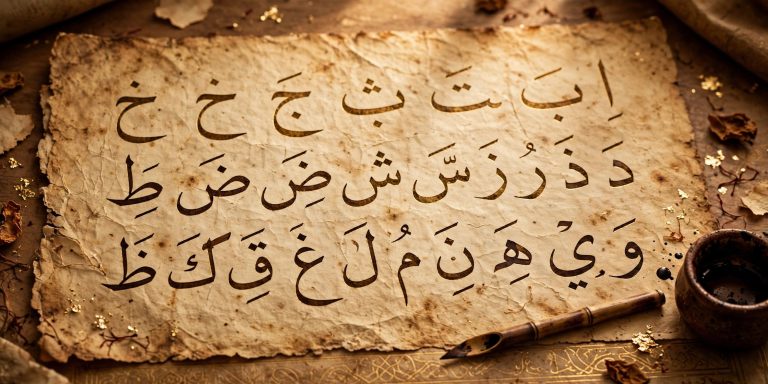
Goal: Recognize and pronounce all 28 Arabic letters confidently.
Weeks 1–2: Isolated Letters
- Learn 4 letters per day — their names and sounds
- Practice writing each letter (writing cements memory)
- Give extra attention to unfamiliar sounds: ح، ع، خ، غ، ق، ض (these don’t exist in English)
Weeks 3–4: Letter Forms and Joining
- Learn how letters change shape at the beginning, middle, and end of words
- Practice joining: ب + ا + ب = باب (baab)
- Read simple three-letter words
Milestone: You can read any isolated Arabic word slowly and correctly.
Phase 2: Vowels and Word Formation (Days 31–60)
Goal: Read words with vowel markings (Harakat).
Weeks 5–6: Short Vowels
- Fatha (َ) produces an “a” sound, Dammah (ُ) a “u” sound, Kasrah (ِ) an “i” sound
- Practice: بَ بُ بِ، تَ تُ تِ
- Read simple words like كَتَبَ (kataba — “he wrote”)
Weeks 7–8: Sukun and Tanween
- Sukun (ْ) means no vowel on the letter
- Tanween (ً ٌ ٍ) adds an “n” sound: “an,” “un,” “in”
- Practice reading words that combine these markings
Milestone: You can read short Arabic sentences slowly.
Phase 3: Fluency and Basic Tajweed (Days 61–90)
Goal: Read Quranic verses with foundational Tajweed.
Weeks 9–10: Essential Tajweed Basics
- Madd Asli — natural elongation (2 counts)
- Noon Sakinah rules — the basics of Izhar and Ikhfa
- Qalqalah — the “bounce” on certain letters
You don’t need advanced Tajweed yet — just enough to read correctly and avoid major errors.
Weeks 11–12: Reading the Quran
- Start with Al-Fatihah — memorize it and read it daily
- Move to short surahs: Al-Ikhlas, Al-Falaq, An-Nas
- Gradually work into Juz Amma (the 30th part)
Milestone: You can read any page of the Quran — slowly, but correctly.
Daily Practice Schedule (30 Minutes)
| Time | Activity |
|---|---|
| 10 minutes | New lesson (letters or rules) |
| 10 minutes | Review (previous lessons — never skip this) |
| 10 minutes | Reading practice (apply what you just learned) |
Thirty focused minutes daily will take you further than three distracted hours on weekends.
Essential Tools
- Noorani Qaida — the standard beginner textbook used worldwide
- A qualified teacher — essential for pronunciation; you genuinely cannot hear your own errors
- A clear Mushaf — larger text is easier for beginners
- A notebook — writing letters by hand significantly improves retention
Common Beginner Mistakes
| Mistake | How to Fix It |
|---|---|
| Skipping writing practice | Write every new letter at least 10 times — it works |
| Learning without a teacher | Get one, even online. Self-taught pronunciation develops hidden errors |
| Rushing through phases | Master each phase before moving on; foundations matter |
| Inconsistent practice | 30 minutes daily beats 3 hours weekly — every time |
A Note for Adult Learners
Adults often learn faster than children because they understand rules better, practice more deliberately, and can use transliteration as a temporary bridge.
Where adults typically struggle:
- Pronunciation — adult mouths are less flexible with new sounds (a teacher helps enormously here)
- Time — busy schedules compete with practice (the 30-minute daily minimum solves this)
- Embarrassment — feeling awkward as a beginner (remember: every Qari started exactly where you are)
The solution is the same: 30 minutes daily, patience with yourself, and a teacher for feedback.
Frequently Asked Questions
Q: Can I really learn to read the Quran in 90 days?
A: With consistent 30-minute daily practice and a teacher’s guidance, many beginners do. Some take 60 days; others need 120. The timeline matters less than the consistency.
Q: Should I also learn the Arabic language?
A: Focus on reading first. Arabic language study can come later — or alongside — but don’t let it delay your reading progress.
Q: I struggle with reading in general. Can I still learn?
A: Yes. Multisensory methods help enormously: trace letters with your finger while saying the sounds aloud, write repeatedly, and use color-coded materials. Many learners with reading difficulties succeed with these approaches.
Q: Is transliteration (Roman Arabic) okay to use?
A: As a temporary bridge, yes. But aim to transition to Arabic script as soon as possible — transliteration can’t capture the sounds accurately long-term.
Summary
Ninety days, three phases: alphabet (30 days), vowels (30 days), fluency (30 days). Thirty minutes a day. Get a teacher — this isn’t optional for pronunciation. Write to learn, don’t rush, and trust the process. You’ll be reading the Quran.
Start your journey today: Book 3 free trial classes or message us on WhatsApp.